

Building Complete Streets at Caltrans
Caltrans is committed to creating Complete Streets—safe, accessible, and connected transportation networks for all users. These projects integrate walking, biking, transit, and driving options to support healthier, more sustainable communities.
How Are Caltrans Projects Built?

How We Deliver Projects
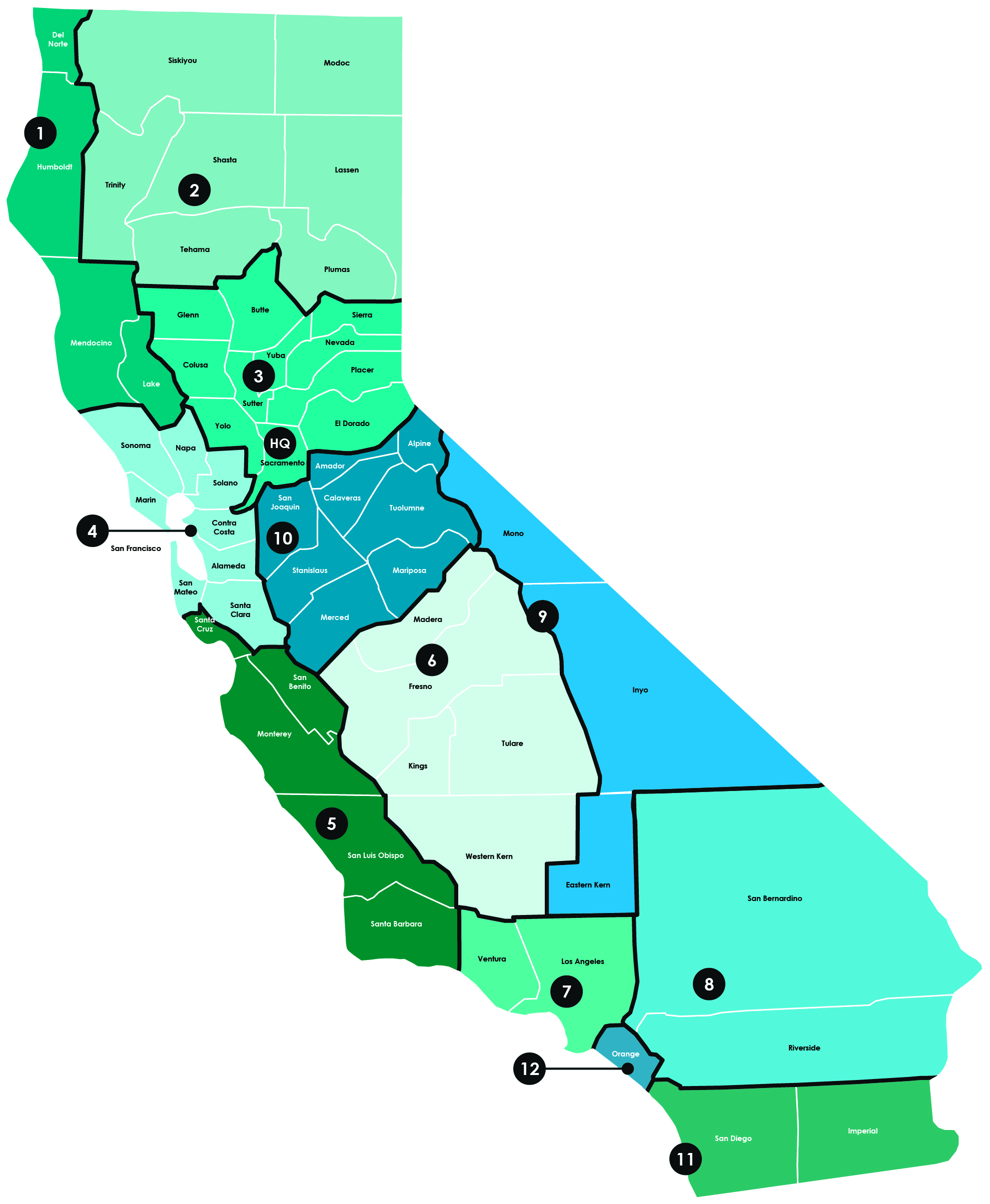
- Headquarters (HQ) sets statewide policy, guidance, and standards to align projects with California’s transportation goals.
- Districts lead the on-the-ground delivery of Complete Streets projects, ensuring designs meet local needs and conditions.
Need local support? Use the information below to navigate to the appropriate Caltrans District website based on region.
Lead Advisor for Complete Streets
District Complete Streets Coordinators
Funding Complete Streets
The primary funding source for Complete Streets improvements is the SHOPP. These funds incorporate Complete Streets elements into rehabilitation and safety projects on the state highway system. Additional funding may come from federal programs, local partnerships, and other state initiatives, helping Caltrans maximize opportunities to deliver multimodal improvements. The graphic below identifies some specific funding streams and programs that are provided by the State of California, as well as funding streams that are more specific to Caltrans.

Current projects in the SHOPP 10 Year Project Book can be found online. You can search this map to see the locations of Complete Streets projects currently planned & programmed in the SHOPP through the Caltrans Project Portal here: SHOPP Interactive Dashboards (Webpage)
Complete Streets projects funded by SB1 can be found in the online Building CA Map here: Building CA Maps (Webpage)
Complete Streets Decisions
The Complete Streets Bill (SB 960), requires that Caltrans publicly post justifications whenever complete streets are not included in a manner consistent with Department guidance. These justifications are called Complete Streets Decision Documents (CSDDs). Click to learn more about the specific requirements of the bill related to CSDDs.
The Complete Streets Bill of 2024, also referred to as SB 960 (Chapter 630, Statutes of 2024), was enacted in September 2024. This legislation formalized and extended many of Caltrans’ ongoing initiatives aimed at enhancing complete streets, building upon Caltrans’ efforts to integrate safe and accessible bicycle, pedestrian, and transit facilities into projects on the state highway system (SHS).
For projects funded through the state highway operations and protection program (SHOPP), Government Code Section 14526.8 mandates Caltrans publicly post justifications on the Department’s public internet website whenever complete streets facilities are not included in a manner consistent with Department guidance. Caltrans project development teams consider complete streets needs at every project phase:
- Project scoping, when the Project Initiation Document (PID) is developed,
- At the environmental review phase, known as the Project Approval/Environmental Document (PA/ED) phase, and
- At the detailed design phase, when the Plans, Specifications, and Estimates (PS&E) are finalized.
At the PID phase, the project team identifies and documents complete streets scope included in the project and provides justification if such scope cannot be included in the project. As teams develop and deliver these projects, they revisit and reaffirm the identified complete streets scope in the PA/ED and PS&E phases. Any changes to complete streets scope must be documented and justified at each phase.
Before SB 960 was passed, District Directors approved these complete streets scope decisions. With the enactment of SB 960, these decisions and justifications must be approved by the Caltrans Director or an executive who has been delegated authority by the director. The Caltrans Director delegated this approval authority to the Deputy Directors of Planning and Modal Programs and Project Delivery. This headquarters review and approval brings a higher level of accountability for Caltrans to implement complete streets and supports consistency statewide.
The documents posted here provide justifications for complete streets scope decisions approved since January 1, 2025. Additional justification documents will be posted at regular intervals to comply with the requirements of SB 960.
CSDD Reporting
The initial justifications illustrate the department's commitment to delivering on complete streets:
- Fewer than 7% of all Caltrans projects under development had to justify not providing complete streets facilities in 2026.
- Just 42 out of 665 SHOPP projects that completed the PA/ED or PS&E phase between January 1, 2025 and June 30, 2026 required justifications for changing the scope of complete streets facilities included in the project.
- 30 of those projects reduced the complete streets scope
- 7 changed the complete streets scope
- 5 added new complete streets scope
- The most common reason for omitting complete streets features from projects was the fact that SHOPP funds cannot be used to construct facilities outside the State right-of-way.
- Just 3 out of 118 newly programmed PIDs initiated in the 2026 SHOPP PID Cycle provided justifications for not including all applicable complete streets facilities.
- 2 of 3 projects reduced complete streets scope since the recommended improvements are being addressed in other projects.
- Just 42 out of 665 SHOPP projects that completed the PA/ED or PS&E phase between January 1, 2025 and June 30, 2026 required justifications for changing the scope of complete streets facilities included in the project.
District Justifications
See below for PDF versions of justifications for not including CS elements in projects, organized by Caltrans District. Any Districts not present did not have justification documents.
- CSJustification_11-43031_PSE (PDF)
- CSJustification_11-43091_PAED (PDF)
- CSJustification_11-43095_PAED (PDF)
- CSJustification_11-43100_PSE (PDF)
- CSJustification_11-43142_PAED (PDF)
- CSJustification_11-43088_PSE (PDF)
- CSJustification_11-43140_PAED (PDF)
- CSJustification_11-43154_PAED (PDF)
- CSJustification_11-43155_PAED (PDF)