

What are Complete Streets?
A Complete Street is a transportation facility that is planned, designed, constructed, operated, and maintained to provide comfortable and convenient mobility, and improve accessibility and connectivity for all road users, with a specific regard for pedestrians, bicyclists, and transit riders. In order to realize our goal to create a world-class state transportation network, Caltrans must recognize and address mobility beyond vehicle drivers.
Complete Streets at Caltrans
Complete Streets are, at their core, a multidisciplinary undertaking and require a collaborative approach. For that reason, Complete Streets at Caltrans involve several functional units, each with their own unique roles and responsibilities.
Caltrans headquarters sets policy and develops statewide guidance, tools, training, and reporting requirements for Complete Streets, while Caltrans Districts implement policy, coordinate locally, and deliver on the ground design, construction, and maintenance of complete streets projects across 12 different regions of the state.
Complete Street Functions
Planning & Modal Programs
Plans and tools to identify location-based Complete Streets needs
Project Delivery
Design guidance, training and asset management for Complete Streets facilities
Maintenance
Training, guidance and support related to maintenance of complete streets facilities.
Traffic Operations
Encroachment permits and operations related to complete streets facilities.
Safety Programs
Programs, research and expertise related to safety of bicyclists & pedestrians on the SHS.
Local Assistance
Technical assistance & administration of the Active Transportation Program (ATP).
Director's Office Of Equity and Tribal Affairs
Plans, guidance, tools, and training for equitable Tribal and community engagement
Director's Office of Sustainability
Strategic policy, tracking, and reporting of departmental Complete Streets goals
Caltrans Districts
Plans, constructs, operates, and maintains complete streets facilities in collaboration with local and regional partners
Program Impact

Dollars Spent
New Bikeway Lane Miles
New and Reconstructed Sidewalks
Caltrans, 2025, Select SHS Project Outcomes; Caltrans, 2025, 2025 Draft SHSMP
Complete Streets FAQs
What are some examples of Complete Streets improvements?
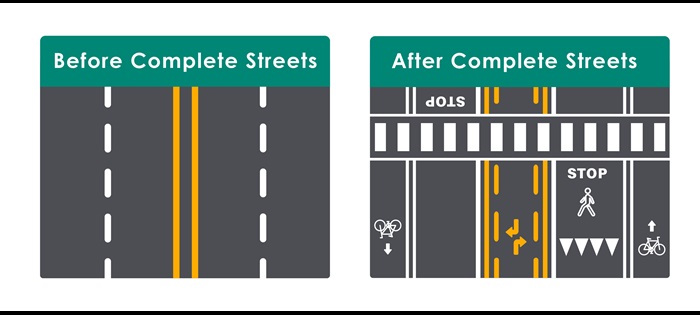
Complete Streets improvements can range from simple, low-cost fixes (high-visibility crosswalks, curb-ramps, wayfinding and signage) to larger capital projects (protected bike lanes, shared-use paths, transit boarding islands, and road diets). Caltrans policy and guidance encourage a mix of these elements depending on context and community need. These elements work together to create safer, more accessible, and multimodal transportation corridors for all users.
How is Caltrans tracking Complete Street progress?
For the first time, the 2021 State Highway System Management Plan (SHSMP) set performance targets for Complete Streets, measuring bikeways, sidewalks, and crosswalks in linear feet. Future SHSMP's will continue to set performance targets for Complete Street facilities. In addition, the Complete Streets Action Plan identifies and tracks key, high-priority efforts to implement the Director's Policy for Complete Streets (DP-37).
How much funding has gone toward Complete Streets at Caltrans since 2020?
Starting in 2020, Caltrans significantly scaled up investment in Complete Streets, beginning with a $100 million funding reservation to serve as a stopgap as permanent funding was identified for bicycle and pedestrian facilities. The 2021 SHSMP programmed about $1.6 billion for complete streets improvements over a 10-year horizon, and by 2023, that figure grew to nearly $2.4 billion with additional federal and state funds identified.
Is Caltrans required to include Complete Streets in projects?
Caltrans's Director's Policy for Complete Streets (DP-37), adopted in December 2022 requires all transportation projects funded or overseen by Caltrans to provide safe, connected facilities for walking, biking, and transit unless an exception is documented and approved. Recent legislation, Senate Bill 960, requires these exceptions to be signed by the Caltrans Director.
CS Hub Quick Links
Contact Us
Website Feedback
Your feedback is important to us and we strive to meet your expectations. Please take a few moments to provide your insight into how we may improve your online experience on the Complete Streets Hub.