

Division of Maintenance photo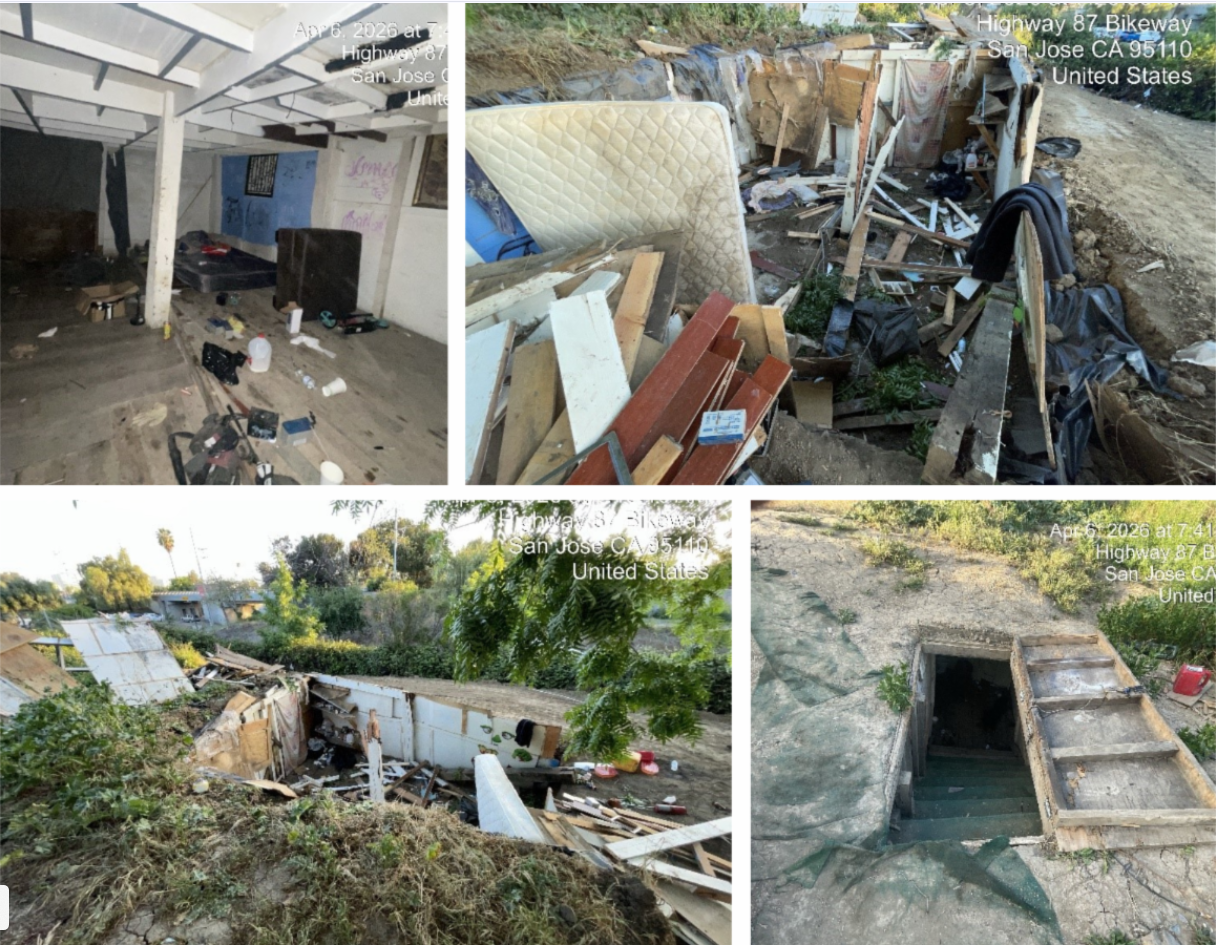 One interesting discovery led to another as Caltrans crews worked to clear an encampment near northbound State Route 87 in San Jose,.
By Alisa Becerra and Alyson Hanner
Division of Maintenance, Office of Homelessness and Encampments
Hidden beneath the packed earth along the state right of way near northbound State Route 87 in San Jose, Caltrans crews uncovered something entirely unexpected.
What appeared at first to be a routine encampment cleanup quickly shifted when staff noticed an opening partially concealed by soil and debris. A closer inspection revealed a secret underground shelter, carefully tucked beneath the roadway, invisible to passing traffic and easily missed during surface level checks.
The discovery occurred near Willow Street, where a site assessment confirmed that the shelter’s entrance had been deliberately obscured by trash and vegetation, allowing the encampment to remain undetected for months. After documenting the location, Caltrans coordinated with local partners and the California Highway Patrol (CHP) to evaluate conditions, monitor safety, and notify occupants of the need to vacate.
During the initial inspection, one occupant explained that the underground shelter had been altered months earlier. As crews looked deeper into its origin, research revealed a startling truth: the chamber was not newly built at all, but the last remnant of a long-forgotten basement, an artifact from a home removed by the city of San Jose, decades earlier to make way for the rising highway above.
Caltrans put together a team of specialists from the Office of Homelessness and Encampments, the Division of Maintenance, the Division of Engineering Services, and the CHP, to check the site out.
Reaching the underground structure was no simple task. Crews pressed forward through a series of secured access points, three heavy doors in all, each one resisting as officers rammed it open. Behind every threshold lay new obstacles: bulging bags of recycling stacked deliberately to conceal the next barrier, forcing the team to push through layer after layer while announcing their presence into the darkness.
When the final door gave way, the space opened before them like a secret chamber. The team advanced in measured steps, their flashlights cutting through the stale air as they tried to make sense of what they had found, what filled the room, and what hidden risks might linger beneath the roadway.
One thing was certain: this was no ordinary encampment removal. The structure could not be safely removed through standard procedures. This would require a costly excavation and would require complete removal of the subterranean space, restoration of the landscape above, and careful backfilling to stabilize the ground. This had to be done with urgency.
Planning began immediately, including discussion on how we would pay for this. Formal notifications were issued to the occupants to vacate: the site would be closed, cleared, and restored.
In April 2026, Caltrans successfully completed the encampment removal and excavation of the underground structure, the remnants of a dwelling long since gone. During restoration activities, crews also uncovered a previously buried drainage facility, allowing it to be restored as part of the project.
In the end, the underground encampment was removed, the slope repaired and reshaped, and the damaged drainage restored to its intended use. The hidden chamber is now gone, its hazard resolved. What remained was the imprint of extraordinary collaboration: multiple Caltrans divisions and partners working in lockstep to reclaim this space safely. Proving that sometimes you have to dig deep to find solutions.
For more information on this and other encampment related stories or to learn more about the Office of Homelessness and Encampments, click here.