

District 10 photo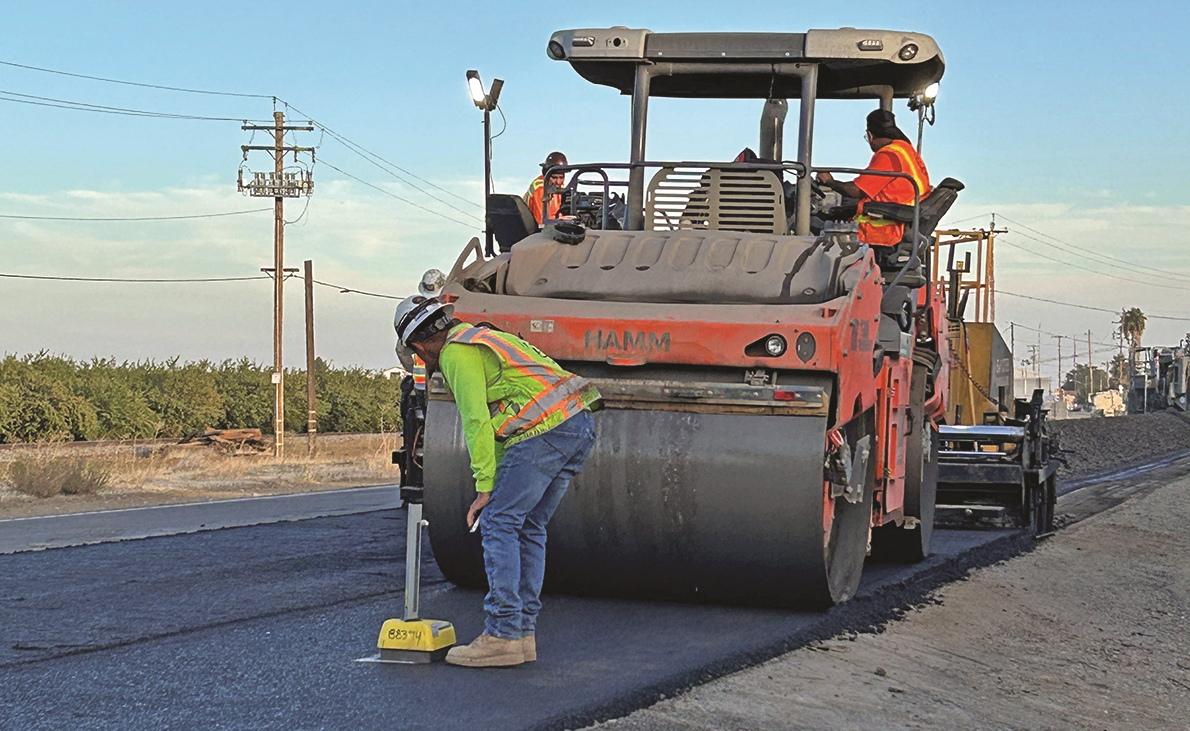 Partial Depth Recycling (PDR) saves time, money and natural resources.
By Erin McQueary
District 10 public information officer
A recent repaving project on State Route 33 in West Stanislaus County used Partial Depth Recycling (PDR), an innovative pavement rehabilitation method that saves time, money and natural resources by making new pavement out of old pavement.
PDR grinds the top three to five inches of existing asphalt and blends it with a recycling agent such as foamed asphalt or emulsified asphalt to create new pavement material.
By reusing the existing roadway instead of hauling in large quantities of new aggregate and asphalt, PDR significantly reduces the use of non‑renewable resources such as fossil fuels and virgin aggregate. It also delivers meaningful initial cost savings — at least $100,000 per lane‑mile, according to District Pavement Coordinator Karen Bonnetti-Ramirez
Construction is typically faster with PDR because crews do not need to remove and replace large sections of pavement or transport large amounts of material. “It’s like having a hot mix asphalt plant right on the road,” Karen said.
Beyond efficiency and sustainability, PDR also improves pavement durability. The recycling and stabilization process produces a stronger, more resilient pavement layer that performs better under traffic loads and resists cracking more effectively than conventional mill‑and‑fill repairs. This durability translates to significantly longer pavement life cycles and fewer disruptive maintenance needs in the years ahead.
The SR‑33 effort is one of nine Caltrans District 10 projects using Partial Depth Recycling, and more are being planned. Karen also noted that several additional projects are in the conceptual phase and plan to use Full Depth Recycling, a similar technique that recycles pavement all the way down to the aggregate base while requiring minimal new materials.