

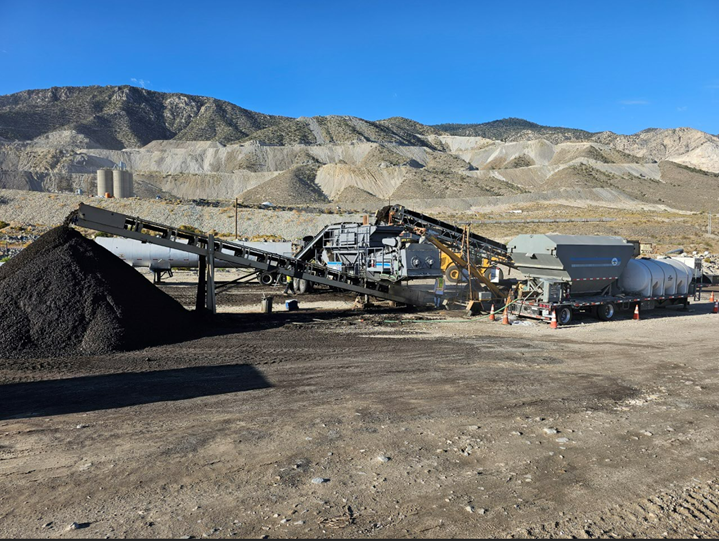
District 8 photo
By the Division of Maintenance
Caltrans' Division of Maintenance continues to be a leader in advancing sustainable pavement solutions with the growing adoption of Cold Central Plant Recycling (CCPR).
In partnership with industry experts and academic researchers through the Pavement and Materials Partnering Committee (PMPC), Caltrans has worked to create clear, consistent guidelines for cold recycling — a method of reusing old pavement materials without applying heat.
Cold recycling includes two main approaches: Cold In-Place Recycling (CIR), where the existing road is ground up, treated and compacted right on site; and CCPR, where the old pavement is removed, processed at a nearby mobile plant, and then brought back to the site to be laid down as a new base layer.
These standardized CCPR guidelines were officially published in Caltrans' construction specifications in October.
With these standards in place, Caltrans can more easily use CCPR to maintain and rehabilitate asphalt roads across the state, according to Leo Mahserelli with Caltrans’ Headquarters Office of Pavement Recycling and Job Order Contracts.
CCPR is a flexible option that works well when more control is needed during the recycling process or when on-site recycling isn’t practical — such as roads with sharp curves, steep terrain or limited space for equipment. It can also serve as an alternative to other cold recycling methods or even be used in new construction projects.
With four pilot projects already completed, CCPR is proving to be a viable alternative to other cold recycling strategies, especially when in-place methods aren't feasible due to physical constraints. The new standards now make it easier to apply this method across California’s roadways.
Ongoing research continues to improve the strength, durability and environmental benefits of CCPR — through better mix designs, low-carbon cement alternatives, advanced emulsions and enhanced pavement design tools such as California Mechanistic-Empirical (CalME), which helps engineers create longer-lasting, more efficient roadways.
The Office of Pavement Recycling and Job Order Contracts works with Caltrans’ 12 districts and various stakeholders on prioritizing pavement recycling under appropriate pavement applications, which includes partial depth recycling, full depth recycling and cold central plant recycling. The benefits include lower capital costs, lower global warming potential, reduced material to the landfills, and aligning with Caltrans goal for sustainability.
The office also assists districts in implementing Job Order Contracting (JOC), which is a project delivery method utilized to deliver projects comprised of numerous, non-complex, commonly encountered and repetitive tasks whose scope is narrow. The benefits would include time savings and reduce procurement support costs for the department.