

District 9 photo
By Michael Lingberg
District 9 Construction public information officer
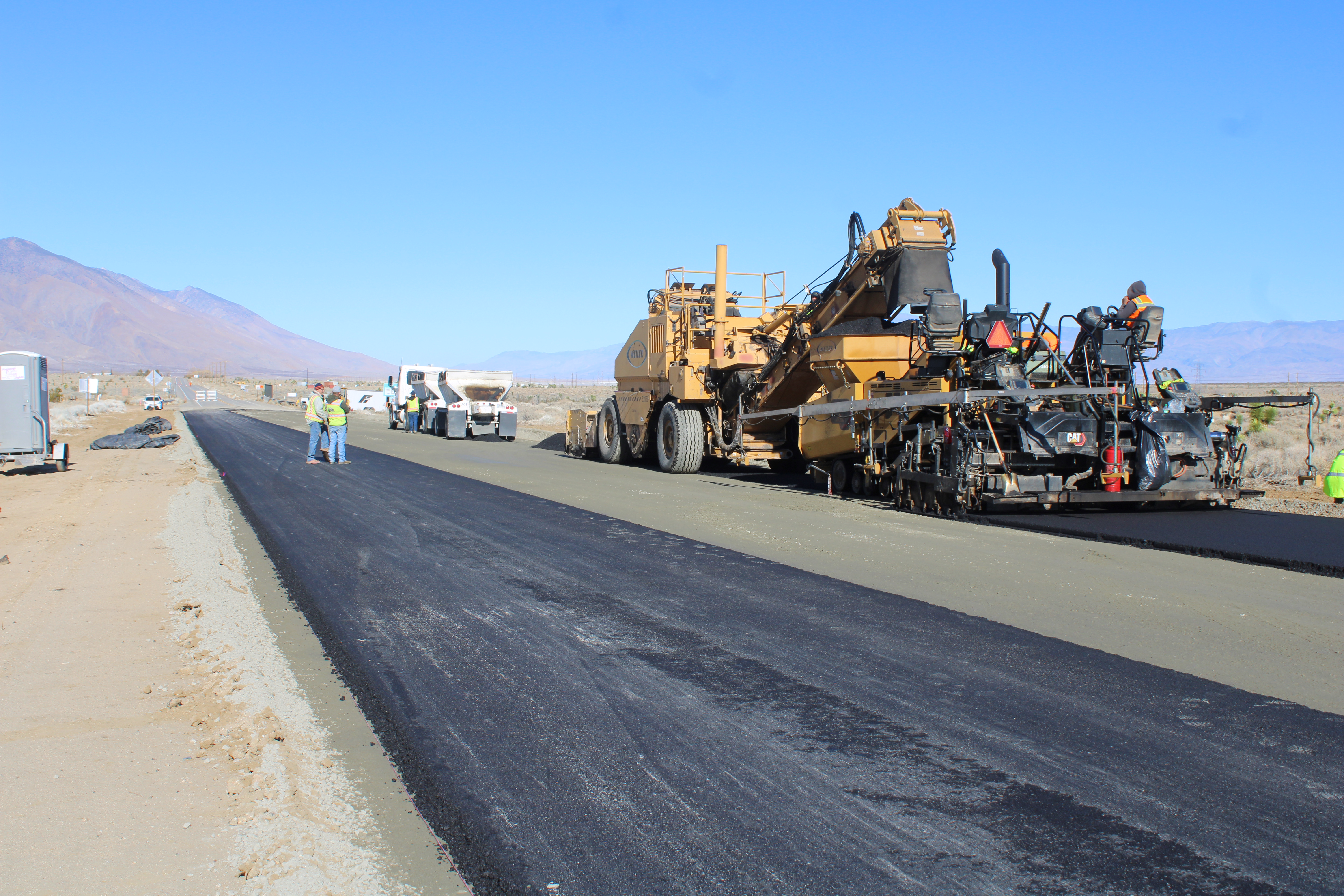
The most significant project in the long history of Caltrans District 9 is now complete. The Olancha-Cartago 4-Lane Expressway Project constructed 12.5 miles of new roadway on U.S. Highway 395, the final stretch of U.S. 395 to be converted to four lanes in Inyo County.
The project was initiated in the District 9 Planning branch in 1998, and studies of possible bypasses in the area go as far back as the 1960s. Fisher Sand & Gravel started construction on this project in January 2022.
This project presented many challenges throughout the life of the project, including work stoppages, design changes and severe weather, but crews persevered and saw it through to the end.
Before work on the new lanes began, crews relocated nearly 150 Joshua trees and several desert tortoises within the project area; both Joshua trees and the desert tortoise, symbols of the Mojave Desert, are endangered species.
Meanwhile, crews built a desert tortoise fence that marked the boundaries of the Caltrans right of way to prevent these reptiles from entering the roadway. Instead, these fences will direct the tortoises towards using the many undercrossings that also function as drainage.
An old water tank on which cowboys from a century ago left their signatures was removed from the project site and donated to the Eastern California Museum in Independence.
Work on the new lanes started with crews scrubbing the land of vegetation and rocks, first creating a rough dirt road for construction traffic.
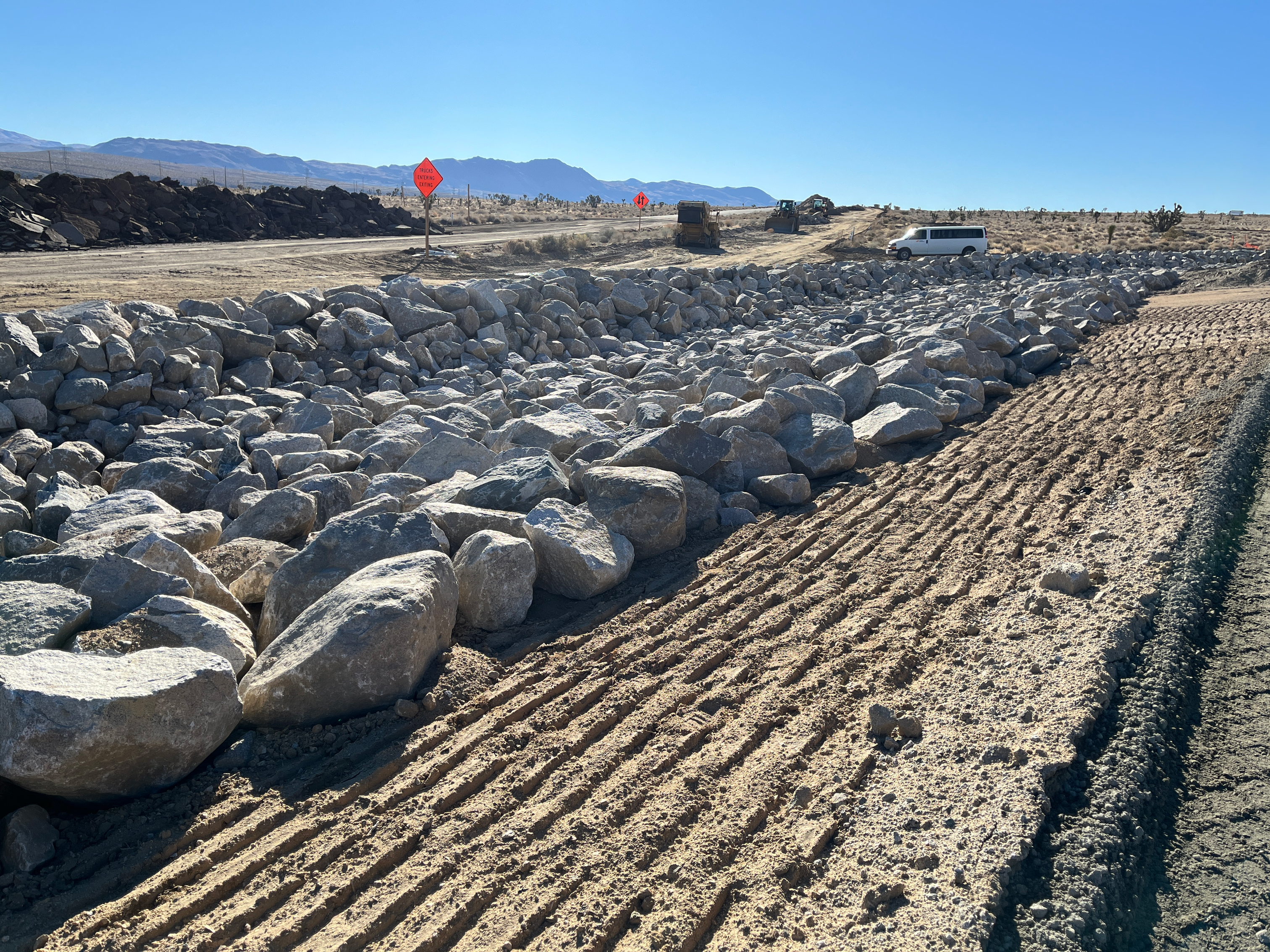
To break up the rocky ground, District 10 bulldozers equipped with long, sharp ripper shanks pierced the soil, loosening up the soil and large granite stones and boulders, some of which included evidence of Native American culture such as grinding stones spotted by Native American cultural monitors stationed throughout the construction site. These stones were gently wrapped up to be transported to other parts of the project or donated to the local Native American tribes.
Larger-than-life Volvo dump trucks continuously transported rock and earth to different areas of the project, such as the material handling site discussed in later paragraphs.
The use of a temporary rock crusher and asphalt production were constructed on the material plant on-site. Before large boulders were harvested from the construction site, they would be broken down before they were transported to the crusher.
District 9 photo
This machine utilized this broken-down granite harvested from the alluvial fan at the base of the Sierra Nevada within the project area to create aggregate base and asphalt production. (An alluvial fan is a fan-shaped formation made up of site rock and other debris after heavy, unexpended rains through a narrow canyon over millions of years. By October 2025, crews had moved approximately 1.6 million yards of earth through the project and laid 290,000 tons of fresh asphalt.
Part of the new roadway follows an old Southern Pacific railroad line that transported ore from mining operations such as Cerro Gordo on the opposite side of Owens Lake to Los Angeles and beyond. “The Railroad Cut” refers to a hill through which the railroad; during the Olancha-Cartago project, the railroad cut was significantly widened and completely transformed to accommodate a 4-lane divided expressway rather than a single railroad line.
Remarkable features of this project include a new screen wall in Cartago that’s the result of collaboration between Caltrans and the local Native American tribes, including the Lone Pine Paiute-Shoshone tribe, and bridge construction over the Los Angeles aqueduct in conjunction with the Los Angeles Department of Water and Power.
This was an atypical project in many ways, including the fact the undertaking was redesigned several times during the construction phase. The heavy storms in 2022 and 2023 set crews back significantly, but this project was also an indication of the resilience and toughness of everyone involved on the project. Throughout the last three-plus years, the desire of everyone to push the project forward never wavered.
The new southbound lanes opened to live traffic in October 2024, and the northbound lanes partially opened a month later. This project cost approximately $165 million, $33.9 of which came from the bipartisan Infrastructure Investment and Jobs Act of 2021 (IIJA).
District 9 Public Affairs hosted a ribbon-cutting ceremony on Oct. 23, 2025, to celebrate the end of major construction of this major project that increased safety for the residents of Olancha and Cartago, as well as the general traveling public. This road is now able to handle current and future traffic demands.