

Quiguil Viaduct Permanent Restoration


Project Description
Quiguil was a place name recognized by the Mission San Antonio priests, and later by Gibson (1983:115) as a multi-village Salinan district. One known baptized person was from “las rancherías de Quiguil [the villages of Quiguil]”. Some references mentioned locations on the seashore, such as the “Mar por la parte de Quiguil [the portion of the sea shore in Quiguil]”, “Mar de Quiguil [the sea shore of Quiguil]”, and “Ranchería del Mar de Quiguil [the ranchería of the sea shore of Quiguil]”. (Milliken and Johnson 2005: 89)
The project name Quiguil was considered and selected in consultation with California Native American Coordinator Terry Joslin Azevedo and Patti Dutton, Salinan Tribe on Monterey and San Luis Obispo Counties. Quiguil is located in the Lopez Point Region, were Limekiln Creek is located.
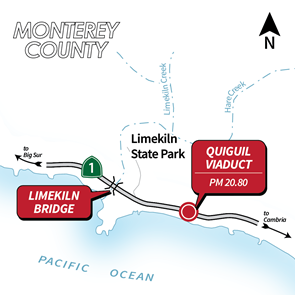
Construction of a 180-foot-long viaduct with four-foot-wide shoulders will replace a damaged retaining wall. No tree removal or significant vegetation removal is proposed as part of the project. Approximately 225 feet of existing guardrail on the southbound side of the roadway will be replaced with guardrail that meets current safety standards. Approximately 225 feet of new guardrail will be placed on the southbound side of the roadway. Options for rail type are being considered, including 86H and Type 85. There will be a soldier pile wall with timber lagging on the inland side of the roadway under the viaduct. Approximately 8.5 vertical feet and 180 horizontal feet of soldier pile wall will be above finish grade. No utility relocation is anticipated as there are no existing overhead utilities within the project limits. No shoulder widening is proposed as part of this project. Equipment needed to construct the viaduct include heavy machinery such as cranes, excavators, concrete mixers, and pile drivers. During construction, a reverse traffic control system will be implemented. One lane will be closed during construction of respective side of the viaduct. All work and staging will be done on the existing roadway and vehicle turnouts adjacent to the project site. The project will take approximately 350 working days, and night work is anticipated. The first stage of the project will move traffic to the northbound lane using one-way reversing traffic control and demolish the existing southbound lane. Once the southbound lane is demolished work will begin to build the southbound viaduct. The second stage will move traffic to the new southbound lane using one-way reversing traffic control, and construction will begin to demolish the existing northbound lane and begin to build the northbound viaduct. All work activities will take place within the Caltrans Right-of-Way.



Project Benefits
Purpose
- The purpose of the project is to construct a viaduct to replace damaged but temporarily stabilized retaining wall under an emergency contract.
Need
- The project is needed to construct a viaduct and upgrade existing guardrail locations to comply with MASH standards. The project is in Monterey County, near Lucia, at 0.1 miles south of the Limekiln Creek Bridge. The combination of saturated ground along with continued heavy rain and winds from the multiple large rainstorm events from December 2022 through January 2023, resulted in multiple landslides, embankment failure, and debris flows which directly impacted the highway and its related systems. Emergency repairs were done to restore essential traffic, minimize the extent of existing damage and protect the remaining roadway. This project intends to provide a more permanent solution.
Proposed Project Schedule
| Process | Date |
|---|---|
| CEQA Categorical Exemption and Caltrans Project Approval | April 2026 |
| Right-of-way acquisition to be completed | August 2027 |
| Design to be completed | December 2027 |
| Advertise | March 2028 |
| Construction to begin | June 2028 |
| Construction to be completed | February 2030 |
Project Contact
Lucas Marsalek, Senior Environmental Scientist (Supervisor)
Phone: 805-458-5408
Email: lucas.marsalek@dot.ca.gov
Eduardo Enriquez, Environmental Scientist
Phone: 805-779-0803
Email: eduardo.enriquez@dot.ca.gov
Ryan Caldera, Project Manager
Phone: 805-458-8457
Email: ryan.caldera@dot.ca.gov
Documents
Accessibility Assistance: Caltrans makes every attempt to ensure our documents are accessible. Due to variances between assistive technologies, there may be portions of this document which are not accessible. Where documents cannot be made accessible, we are committed to providing alternative access to the content. Should you need additional assistance, please contact us at (916) 654-2852 or visit https://dot.ca.gov/request-ada-compliant-documents.
Title VI Information
The California Department of Transportation (Caltrans) assures that no person shall, on the basis of race, color, or national origin, be excluded from participation in, be denied the benefits of, or be otherwise subjected to discrimination under any program or activity receiving Federal financial assistance, as required by Title VI of the Civil Rights Act of 1964, as amended, the Civil Rights Restoration Act of 1987, and Federal Executive Order 12898 (Federal Actions to Address Environmental Justice in Minority Populations and Low-Income Populations).
Caltrans will make every effort to ensure nondiscrimination in all of its programs and activities, whether they are federally funded or not, and that services and benefits are fairly distributed to all people, regardless of race, color, or national origin. In addition, Caltrans will facilitate meaningful participation in the transportation planning process in a nondiscriminatory manner.
Title VI Brochures
Title VI brochures in various languagesReferences
Gibson, R.
1983 Ethnogeography of the Salinan People: A Systems Approach. Unpublished M.A. Thesis, Department of Anthropology, California State University, Hayward.
Milliken, R., and J. Johnson
2005 An Ethnogeography of Salinan and Northern Chumash Communities – 1769 to 1810. On file at the Northwest and Central Coast Information Centers.