197/199 Safe STAA Access Highway Improvement Project
 The 197/199 Safe STAA Access Highway Improvement Project will upgrade spot locations along U.S. 199 and Route 197 in Del Norte County to allow industry-standard sized STAA trucks. Additionally, safety benefits will likely be achieved through wider lanes, wider shoulders, longer radius curves, and improved sight distance.
The project includes seven locations: Two on Route 197 near Ruby Van Deventer County Park, and five on U.S. 199 in the Patrick Creek area and at Washington Curve. Work includes alignment adjustments, roadway widening, shoulder widening, culvert and drainage work, retaining walls, barriers, pavement work, bridge work, guardrail installation, rock excavation, blasting and slope stabilization.
Caltrans completed environmental review in 2013 following public outreach, including two public meetings. The project later moved through additional approvals in 2023, and construction is currently estimated to begin in summer 2026.
How is safe STAA access helpful?
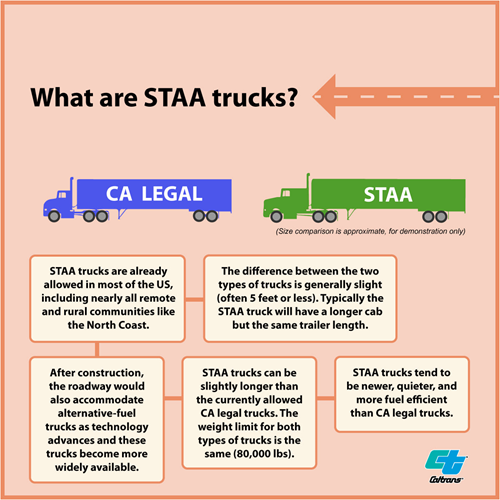
Industry-standard trucks conforming to the Surface Transportation Assistance Act (STAA) are currently restricted on portions of Route 197 and U.S. 199. These locations are among the few remaining gaps on California state highway where industry-standard truck access is not available. STAA trucks are generally about 5 feet or less longer than trucks currently permitted along these routes. As STAA trucks have become the national standard, communities without STAA access can face higher goods-movement costs because cargo may need to be shifted to shorter trucks. Improving this corridor is intended to support safer and more efficient movement of goods.
Project locations
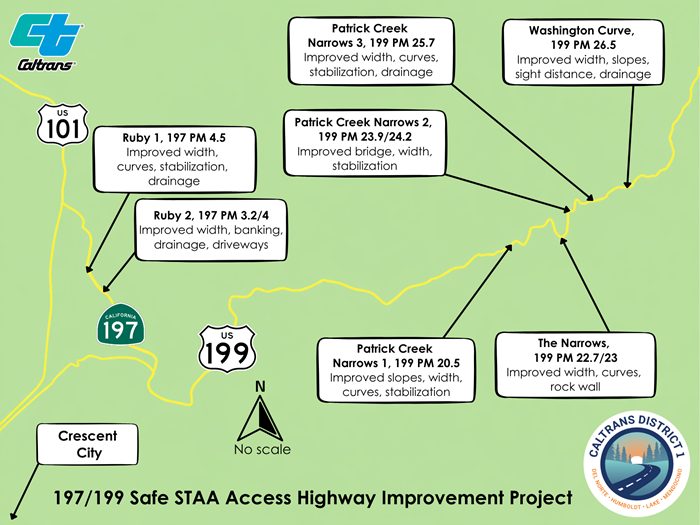
The project is located northeast of Crescent City in Del Norte County. On Route 197, work is located about 3.2 to 4.5 miles from the U.S. 199 junction. On U.S. 199, work is located about 20.5 to 26.5 miles from the U.S. 101 junction.
- Ruby 1: Improve the curve’s shape and banking, widen the shoulder, plus drainage, culvert, and retaining-wall work.
- Ruby 2: Widen the roadway through the curve, improve the curve’s banking, widen shoulders, extend or replace culverts, and rebuild several private driveway connections.
- Patrick Creek Narrows Location 1: Cut back the upslope side, widen the roadway to standard lanes and shoulders through the curve, and add a short barrier/retaining wall.
- The Narrows: Correct the tight curve at the narrow rock pinch point by cutting the rock wall back and creating wider shoulders. The rock wall would be moved back about 8 feet to create 4-foot shoulders.
- Patrick Creek Narrows Location 2: Bridge replacement at the Middle Fork Smith River, along with adjacent roadway widening and retaining-wall work.
- Patrick Creek Narrows Location 3: Widen and realign the roadway to remove the existing S-curve, build a soldier-pile retaining wall, and replace culvert/drainage features.
- Washington Curve: Widen the roadway, cut back the slope and cliff side to improve the curve and sight distance, and replace culvert and drainage inlet features.
Traffic impacts
One-way traffic delays
Through the end of 2029, several work locations will require one-way traffic control with flagging or traffic signals, and travelers should expect delays.
Four-hour full closures
Four-hour full closures are estimated to begin in January 2027 at the earliest and are expected Tuesdays through Thursdays from 10 a.m. to 2 p.m. Full closures will continue as needed through 2028.
Full closures are not expected to happen every week. Caltrans will provide advance notice before full closures.
These closures are expected to reduce the overall project timeline while improving safety for workers and travelers during operations such as rock blasting and slope stabilization. Emergency vehicles will be accommodated through the closure.
Plan ahead
Travelers are encouraged to check Caltrans District 1 social media, the QuickMap app and the weekly Caltrans District 1 Road Information Bulletin before traveling for the latest updates.
Project schedule
- Construction is estimated to begin in summer 2026.
- Four-hour full closures are expected to be complete in 2028.
- Construction is expected to be complete by the end of 2029.
Frequently asked questions
What is an STAA truck?
STAA stands for Surface Transportation Assistance Act. In this context, an STAA truck is an industry-standard truck configuration allowed on designated STAA routes. An STAA truck is a tractor-semitrailer combination authorized on the National Network. These trailers are typically 48 to 53 feet long and require larger turning radii. The 197/199 project is intended to improve specific curves and narrow areas so standard STAA-sized vehicles can travel the corridor more safely.
Will there be increased truck traffic?
A Caltrans analysis estimated STAA access would not result in a major surge in truck volumes. Although it is not possible to predict which route truck drivers will choose, removal of the STAA restriction is expected to improve efficiency for goods movement. Studies showed changes in traffic volumes would be tied to the economic metrics of the area.
Will this project increase vehicle speeds and make the route more dangerous?
No. Posted speed limits will not change as part of this project. Improvements such as wider lanes, wider shoulders, longer curve radii and better sight distance are designed to make the roadway safer.
Will there be excessive noise?
Construction activities such as rock excavation, blasting, hauling and paving will create temporary noise during active work. There are no occupied structures within 250 feet of the Narrows or Patrick Creek Narrows locations that would be affected by blasting or construction noise. All work activities involving blasting will occur during the daytime between 10am and 2pm. =Additionally, there will be hydroacoustic monitoring in place to ensure that noise levels for fish are within acceptable ranges.
Will water quality be affected?
Studies showed the project will have no significant change in water quality. The project is required to comply with all applicable permits, including Clean Water Act Sections 401 and 404, and a Stormwater Pollution Prevention Plan. There will also be an industrial hygienist on site to monitor air and water quality. Additionally, the project includes drainage, culvert, and related roadway improvements at several locations, improving how runoff and drainage are handled.
What about naturally occurring asbestos?
Caltrans has standard specifications that address handling naturally occurring asbestos, which is common among these stretches of highway. The contractor will prepare an asbestos compliance plan and dust control plan before working in locations that may contain naturally occurring asbestos. Asbestos planning was part of project development, and geology, soils, and hazardous materials were also part of the project's environmental review.
Will emergency services be able to get through?
Emergency vehicles will be accommodated when possible. However, during certain full closures, including blasting and rock excavation, no traffic will be able to pass through the work zone until it is safe to reopen. Local authorities will be notified before full closures, and a contingency plan and emergency response action plan will include procedures for emergency vehicle access.
Will the project change the characteristics of the community?
This project is not a remake of the whole area. It focuses on seven spot locations, to fix specific roadway challenges for STAA trucks. The cumulative construction distance is approximately 1.7 centerline miles of highway, with individual work areas ranging from 361 to 1,800 feet. This is targeted highway work, not a broad change to the surrounding communities.
How might the project improve safety?
All seven project locations have roadway geometries that can cause long-wheelbase vehicles to off-track across the centerline, and limited sight distance can reduce reaction time. Improvements such as wider lanes, wider shoulders, longer radius curves and improved sight distance are intended to make the corridor safer and easier to navigate for all users.
Documents
Coming soon
For more information
Project Manager
Izzy Konopa
Public Information Officer (media and other inquiries)
Myles Cochrane
Last reviewed: April 2026