

Tramonto and Castellammare area landslides
Location
Northbound State Route 1/Pacific Coast Highway (PCH) at Porto Marina Way, ¾-miles north of Sunset Boulevard, in the community of Castellammare (the city of Los Angeles).
Background
The Castellammare Mesa area is home to at least two landslides, the Tramonto Slide and the smaller Castellemmare Slide, that have been active since 1932 and have moved slowly over the decades. The slide area is three acres, much larger than the portion visible from the highway.
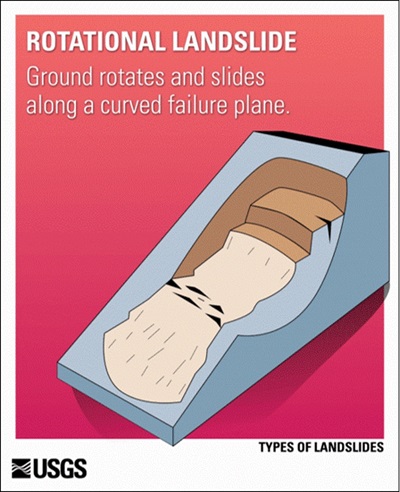
The Tramonto Slide is a deep-seated rotational landslide. Rotational landslides occur along a curved or spoon-shaped surface. There is often a toe of displaced material. Rotational slides often occur because the internal strength of the material is overcome by its own weight. They are usually composed of relatively loose or unconsolidated material. Water has a significant influence.
Deep-seated landslides are typically much larger than shallow landslides, are often slow moving, and can cover large areas.
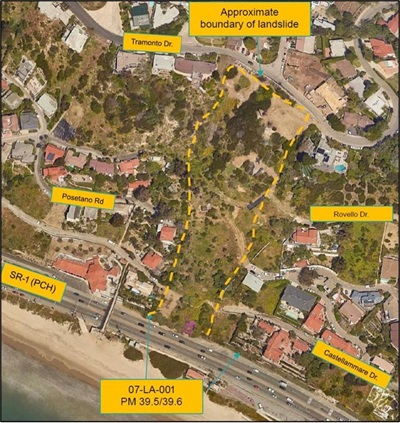
Scope of the Tramonto slide area.
Studies
Caltrans is leading an effort to restore PCH and monitor the two landslides, which have created disruptions to traffic along PCH and damage to residences and city roadways along the hillside over time.
Castellammare Slide: February through May 2026 Caltrans coordinated with the city of Los Angeles and communicated with area residents to conduct field investigations including surface geophysical surveys to ensure the safety of PCH from future storm and slide impacts.
Tramonto Slide: Geophysical surveys and geotechnical drilling were conducted on the Tramonto Slide from August through October 2026.
FAQs
Why is this work happening now?
This work is part of the Director’s Order for emergency projects on Pacific Coast Highway from damages and impacts from the 2025 Palisades Fire and subsequent rainstorms.
What is the full scope of work for the two investigations?
Field exploration consists of seismic refraction surveys, boreholes with soil and rock sampling and, in some cases, downhole geophysical testing and/or installing instrumentation at multiple locations.
A site investigation includes field visits for planning purposes, utility clearance and drilling of soil/rock borings. Following conclusion of the drilling, each borehole has a geotechnical monitoring instrumentation installed that allows engineers and geologists to study the movement of the earth as well as groundwater conditions over time.
Monitoring will be conducted at regular intervals through summer 2027, and the instrumentation will be removed by December 2027. Boreholes not containing instrumentation will be backfilled with cement grout.
The samples will be used to assess current conditions, analyze stability and identify possible ways to strengthen the slope and guide future safety improvements to protect PCH.
Slide activity
February 2024 rainstorms
Slide activity that originated outside of state/Caltrans right of way was caused by a major storm in early February 2024 and further saturated by additional storms in February and March 2024. The Tramonto Slide encroached onto Caltrans right of way, blocking the northbound right lane.
Because the slide was too unstable, Caltrans realigned lanes at that location toward the median on PCH to create a second northbound lane, which was opened to traffic on Thursday, May 30, 2024.
Spring 2025 to present
As part of its recovery efforts from the January 2025 Palisades Fire and subsequent rainstorms, Caltrans crews noticed impacts to PCH near Sunset Boulevard. They suspected the underlying causes of these impacts may have been previous landslide activity. After clearing debris and restoring the state's damaged assets from the fire and storms, crews began the field investigation in February 2026.
Previous research
A joint study was done in 2010 by Caltrans and the City of Los Angeles, one of the property owners. The study documented the history of the slide and recommended that long-term repairs start from the top of the slide.
Research by the Caltrans Right of Way Division has determined most of the property parcels in the slide’s land mass above the PCH are privately owned and some are owned by the city of Los Angeles.
Long-term Mitigation
A permanent resolution to the Tramonto/Castellammare Slide area will be determined through communication with the city of Los Angeles and owners of the residential property outside of Caltrans’ right of way. Long-term mitigation may require construction of infrastructure on private property, including multiple retaining walls. Once the slope has been stabilized from the top, Caltrans can continue with repairs at the bottom of the slide.
There is no estimate of when a mitigation plan will be established, but these studies are a significant step towards that goal.
Contact
For questions and concerns about drilling work on city streets in the slide area, please contact Al Dymally, senior construction engineer with the City of Los Angeles, at al.dymally@lacity.org.
For other information, email Marc Bischoff, Caltrans District 7 public information officer, at Marc.Bischoff@dot.ca.gov.