

Caltrans D4 Fuel Reduction Projects at SR-1 & SR-92 in San Mateo County
Caltrans District 4 continues to advance its fuel‑reduction work in San Mateo County to meet State wildfire resilience goals and protect local ecosystems. We are working with local partners to expand areas of work. The work will take place along segments of two highways:
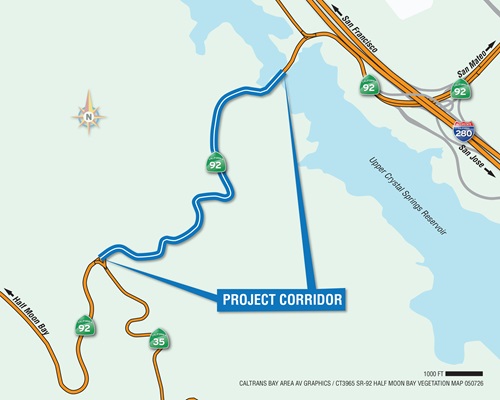
- State Route 92 (SR-92) between Interstate 280 (I-280) and State Route 35 (SR-35), near Crystal Springs Reservoir.
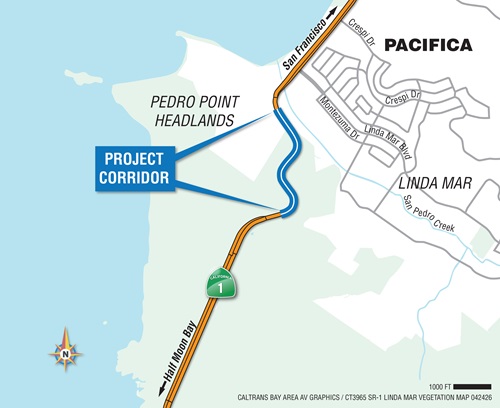
- State Route 1 (SR-1) south of Pacifica near the Pedro Point Headlands.
SR-92 near Crystal Springs Reservoir
Vegetation reduction on SR-92 between I-280 and SR-35 is planned to occur starting in Fall 2026. The San Mateo Resource Conservation District (SMRCD) will be performing this work both within and adjacent to the Caltrans right-of-way.
Work will include:
- clearing areas adjacent to the roadway
- reducing the number of overhanging trees
- thinning vegetation and removing non-native trees and vegetation
- removing dead, diseased, or dying trees
SR-1 near Pacifica
The work on SR-1 will be performed by Caltrans and by the SMRCD. Caltrans will focus on vegetation within Caltrans’ right-of-way, which extends up to about 100 feet from the edge of the roadway. SMRCD work will pick up at the edge of the state's right-of-way and continue up to about 175 feet from the roadway. Caltrans work will include:
- clearing vegetation within 10 feet of the roadway
- thinning and removing ground and ladder fuels near the highway
- removing limbs (“limbing up”) to about eight feet from the ground to create separation between surface fuels and tree canopies
The effort, currently under review through California Natural Resource Agency's (CNRA) permitting process, would cover portions of SR-1 between postmiles 40.1 and 40.7 and is anticipated to begin in the Fall of 2026. Some trees will be removed with priority given to dead, diseased, or dying trees deemed to pose high risk. Smaller trees, in some cases up to ten inches in diameter, may also be removed to reduce fuel load. All areas will be reviewed for nesting activity, including raptors. Work will incorporate watershed and other environmental protections. All workers will be given a Worker’s Environmental Awareness Training (WEAT) prior to all construction activities.
FAQs on Caltrans Fuel Reduction Program
- How does Caltrans designate priority routes for fuel reduction work?
Caltrans uses a science- and data-backed approach for priority route selection, which utilizes data on evacuation routes, vulnerable communities, fire authority input, community wildfire protection plans, and fire hazard severity zones. - How does Caltrans remove vegetative fuels?
Caltrans Field Crews, a Vegetation Management Strike Force Crew, and contractors address vegetation management and fuel reduction work using a number of methods. These methods may include tree removal, tree thinning, mowing, hand removal, and targeted use of herbicide for eucalyptus and other fast-growing, invasive species.
- How does Caltrans balance fuel reduction work with wildlife protection?
Caltrans’ Environmental team assesses all areas for their potential to be habitat for listed species and protected resources. The Environmental team develops a series of best management practices (BMPs) and/or avoidance and minimization measures (AMMs) to ensure listed species are not impacted. AMMs may include, but aren’t limited to, preconstruction surveys by a qualified biologist, nesting bird surveys, full time biological monitoring, flagging of no work zones and environmentally sensitive areas (ESAs) with special restrictions, and/or Workers Environmental Awareness Trainings (WEATs).
- How many acres of Caltrans Right-of-Way are under review?
All Caltrans operating Right-of-Way undergoes vegetation management. Additional attention is paid to areas identified in Cal Fire maps by Caltrans Vegetation Management Crew and through vegetation management contracts. Learn how Caltrans works with partner agencies here: https://dot.ca.gov/caltrans-near-me/district-4/d4-projects/d4-vegetation-management-partnerships
- How do I request fuel reduction work in my area?
Submit a Customer Service Request (https://csr.dot.ca.gov/) or have a conversation with your local fire authority or government.
Project Contact
Nawel Tahraoui
Public Information Officer - Caltrans District 4
Nawel.Tahraoui@dot.ca.gov
(510) 390-3253
Page last updated July 2026