

State Route 16 Cache Creek Rehabilitation Project
Cache Creek Rehab
| Project ID | EA | District | County | Route | Funding Program |
| 0322000086 | 03-2J670 | 03 | Yol | 16 | SHOPP |
Project Description:
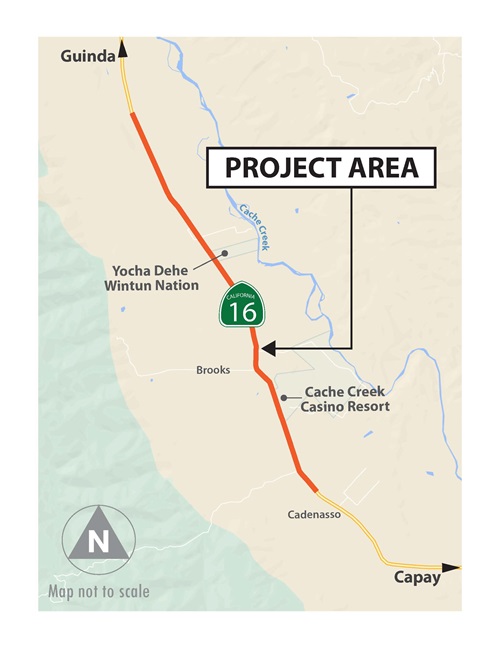
Cache Creek Rehabilitation Project proposes Resurfacing, Restoration, and Rehabilitation (3R) to improve pavement condition and roadway safety. The scope of work includes pavement rehabilitation using full-depth reclamation of the entire road surface, with base materials recycled and reused on site; shoulder widening; replacement and widening of existing bridges with upgraded bridge railings to accommodate standard shoulder widths; replacement of nonstandard guardrails and end terminals in compliance with the Manual for Assessing Safety Hardware (MASH); replacement of nonstandard roadside signs; and implementation of Complete Street features (e.g., signs) where feasible.
Project Map
Project Benefits
Purpose
The purpose of this project is to widen the shoulders to standard width, including at the bridge locations, and to rehabilitate the degraded pavement to restore the facility to a state of good repair. The rehabilitation strategy makes this a 3R (resurfacing, restoration, and rehabilitation) project. As a 3R project, the work not only extends the design life of the pavement structure but also incorporates geometric improvements to enhance overall mobility.
Need:
According to the 2019 Pavement Condition Summary Report (PaveM), the existing pavement exhibited 8.77% Alligator B cracking in 2019, with projections indicating an increase to 32.75% by 2029. The International Roughness Index (IRI) is expected to rise from 186 inches/mile to 216 inches/mile over the same period. Without this 3R project, pavement conditions will continue to deteriorate.
The existing shoulder widths along this segment of SR 16 do not meet current Highway Design Manual (HDM) standards; achieving standard shoulder widths will require bridge widening or replacement. The Winter Creek and Taylor Creek bridges cannot be widened due to structural deficiencies, including critical scour, extensive concrete spalling with exposed reinforcing steel, and low load ratings. Mossy Creek Bridge is structurally capable of being widened to meet the required shoulder width.
Geometric improvements and roadway realignment are also necessary throughout this corridor to improve stopping sight distance on horizontal curves, address significant vertical grade changes, and provide standard shoulder widths. These improvements support mobility and corridor safety.
Safety
Existing shoulders do not meet current shoulder width standards. Multiple guardrails and end terminal systems do not meet current MASH standards and need to be upgraded.
Signs and Striping
Multiple roadside signs have been identified as requiring replacement to comply with current standards. Striping of lanes is required to meet current standards.
Bridgework
During a 1954 project, the highway was realigned and improved. Winter Creek Bridge at PM 16.38 and Taylor Creek Bridge at PM 20.14 were widened, and Mossy Creek Bridge at PM 18.13 was replaced. To accommodate the current project scope, Winter Creek Bridge and Taylor Creek Bridge would be replaced, and Mossy Creek Bridge would be widened.
Replace Winter Creek Bridge and Taylor Creek Bridge:
Due to their current structural integrity, age, and condition, Winter Creek Bridge and Taylor Creek Bridge are identified for replacement. Winter Creek Bridge and Taylor Creek Bridge have experienced scouring leading to exposure of the foundation; the proposed bridges would address channel and bridge integrity.
Widen Mossy Creek Bridge:
Mossy Creek Bridge is a three-span Cast-in-Place (CIP) continuous reinforced concrete (RC) slab with reinforced concrete piles on open diaphragm-type abutments. The bridge is a candidate for widening; it has sufficient foundation capacity and the ability to be widened with additional piles and a widened reinforced concrete slab.
Culverts
Multiple culverts would be replaced in different locations. During a field visit with Design, District Hydraulics provided recommendations for each location. If a culvert was found to be structurally deficient, it was automatically flagged for replacement.
Due to shoulder widening, the ditch flowline must be pushed out approximately 4 to 5 feet; as a result, many culverts within the system would need to be replaced to align with the new ditch flowline. Due to their current conditions and insufficient size, 23 culverts have been identified for replacement. All culverts must be 18 inches in diameter minimum to allow for proper drainage and maintenance purposes.
Four culverts are proposed to be extended. While they were found to be healthy, due to the widening they must be extended to accommodate the new catch point. Four headwalls are proposed to address sediment buildup or maintain the opening within the right of way. Rock slope protection (RSP) is proposed at specific areas along the highway to prevent erosion, with particular emphasis on the lowest point where water tends to accumulate.
Project Documents:
Notice of Intent, Notice of Completion and Draft Environmental Document
The environmental document, referred to as an Initial Study Mitigated Negative Declaration (IS/MND), is available to be viewed digitally on the Caltrans websites
Comment on this project prior to October 9, 2026
Public Meeting: The public meeting is scheduled for October 6, 2026, from 4:30 p.m. to 6:30 p.m. at Western Yolo Grange 16787 Forest Ave B312, Guinda, CA 95637.
Funding
This project is programmed in the 2024 SHOPP and has been funded with the 20.XX.201.122 Roadway Rehabilitation Program as a long lead project.
Cost Estimate:
| Support Cost | $13,670,000 |
| Capital Cost | $32,061,000 |
| Total Project Cost | $45,731,000 |
Schedule:
| Project Approval & Environmental Document | October 2026 |
| Design Completed | March 2028 |
| Advertise Project | September 2028 |
| Begin Construction | December 2028 |
| Complete Construction | October 2030 |
Project Contacts:
Cameron A Haymore, Project Manager, (530) 720-6153; cameron.haymore@dot.ca.gov
Dennis Keaton, Public Information Officer, (916) 826-5252; Dennis.keaton@dot.ca.gov