

I-5 / El Toro Road Interchange Improvement Project
To submit comments on the Draft EIR/EA:
- Mail to Caltrans District 12: Div. of Environmental Analysis, 1750 East Fourth Street, Suite 100, Santa Ana, CA 92705
- Email comments to D12.ELToro@dot.ca.gov with the subject line “I-5 El Toro Road Interchange Project”.
- Provide comments in writing or with a court reporter at an upcoming public hearing.
Introduction
The California Department of Transportation (Caltrans), in partnership with the Orange County Transportation Authority (OCTA), proposes to modify and improve the existing Interstate 5 (I-5)/El Toro Road Interchange between post miles (PM) 17.8 and 19.7, located within the cities of Lake Forest, Laguna Woods, and Laguna Hills in Orange County, California (see Figure 1, Project Location Map). Caltrans, as assigned by the Federal Highway Administration (FHWA), is the Lead Agency under the National Environmental Policy Act (NEPA) and the California Environmental Quality Act (CEQA).
The purpose of the I-5/El Toro Road Interchange Project (Project) is to improve traffic flow, optimize traffic signalization, improve traffic mobility at and through adjacent local street intersections, reduce freeway ramp queuing, and apply technology to help manage traffic demand. The proposed alternatives are: Build Alternative 1 (Southbound I-5 Hook Ramps), Build Alternative 1a (Design Variation), Build Alternative 3 (TSM/TDM), and the No-Build Alternative.
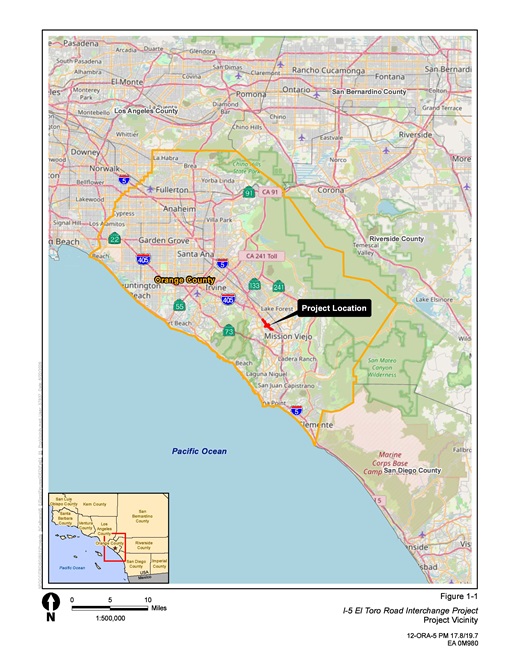
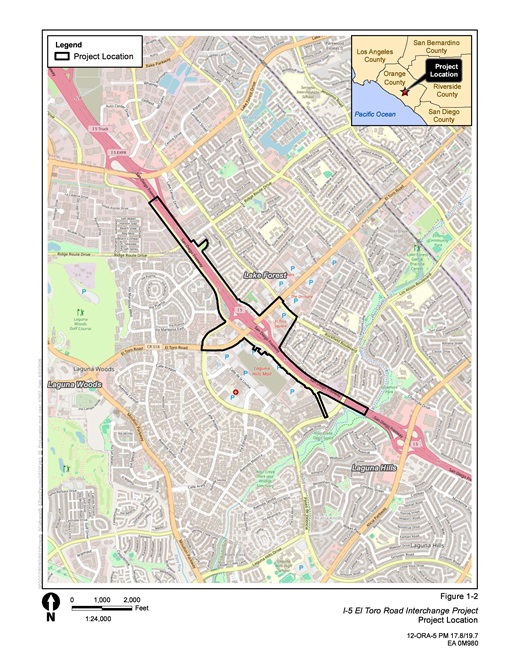
Project Status: Environmental Phase
Caltrans is the lead agency under the National Environmental Policy Act (NEPA) and the California Environmental Quality Act (CEQA). Caltrans is preparing a Final Environmental Document (FED) pursuant to CEQA and NEPA guidelines. The Project is currently in the environmental phase. The Draft Environmental Document (DED) was completed in July 2026, and the FED is anticipated for approval in early 2027. Read more about the environmental study process below.
Environmental Study Process
The environmental study process is an important and mandatory part of project development. This multi-year process includes technical studies and opportunities for public participation and comment, including before and during the DED review phase. It must comply with NEPA and CEQA, as well as any other applicable federal and state laws. Accordingly, Caltrans must analyze potential project alternatives and inform decision-makers and the public about potential environmental impacts.
As part of this process, Caltrans analyzed effects on physical, biological, and human environments. If it is determined that the proposed project may have potentially significant impacts, then measures to avoid, minimize, and/or mitigate those impacts must be considered and implemented. For more information on NEPA, visit the EPA's NEPA website. For more information on CEQA, visit the Governor's Office of Land Use and Climate Innovation's website.
The Project’s environmental review phase began with public scoping in 2023. The purpose of public scoping meetings was to provide information to agencies and the public regarding the proposed project and to obtain feedback on the scope and content that should be addressed in the environmental document. An initial public scoping period was held for a 33-day period between July 11 and August 25, 2023. In response to public comments received during the initial scoping period, Caltrans extended the public scoping period by 45 days, from November 1, 2023, to December 18, 2023.
An in-person scoping meeting was held at the Lake Forest Community Center on Wednesday, July 26, 2023, from 4:00 p.m. to 7:00 p.m. A virtual scoping meeting was held on August 3, 2023 on Zoom. Please see documents from the scoping meetings linked below under Available Resources. The scoping meetings offered the public an opportunity to provide comments during the scoping phase for the I-5 Interstate 5 (I-5)/El Toro Road Interchange Project. Formal public comments were accepted during the scoping period and were documented and reviewed by the Project team.
Following scoping, technical studies were completed. A DED was prepared that included the findings of the environmental studies. The public circulation period for the DED is from July 31 to September 14, 2026. The approval of a FED is anticipated in early 2027.
One No Build Alternative and two Build Alternatives (including one design variation), ranging from $29 million to $333 million for the proposed build alternatives, were studied:
- Alternative No. 1 (Southbound I-5 Hook Ramps)
- Alternative No. 1a (Design Variation)
- Alternative No. 3 (TSM/TDM)
- No-Build Alternative
Draft Environmental Document
The Draft Environmental Impact Report/Environmental Assessment will be made available to the public and circulated to regional and local agencies to provide opportunity for their comments from July 31st to September 14th, 2026.
The document will be available for review below on this website and at the following locations:
- Caltrans District 12 Office, 1750 East 4th Street, Suite 100, Santa Ana, CA 92705 (8am-5pm Monday-Friday)
- Laguna Woods Library, 24264 El Toro Road, Laguna Woods, CA 92637 (9am-5pm Monday-Friday)
- El Toro Library, 24672 Raymond Way, Lake Forest, CA 92630 (10am-7pm Monday-Thursday) ; (9am-5pm Friday & Saturday)
- Laguna Hills Library, 25555 Alicia Parkway, Laguna Hills, CA 92653 (10am-7pm Monday-Thursday) ; (9am-5pm Saturday)
Comments may be submitted during the public circulation period (July 31, 2026 – September 14, 2026) in any of the following formats:
- Mail to Caltrans District 12: Div. of Environmental Analysis, 1750 East Fourth Street, Suite 100, Santa Ana, CA 92705
- Email comments to D12.ELToro@dot.ca.gov with the subject line “I-5 El Toro Road Interchange Project”.
- Provide comments in writing or with a court reporter at the upcoming public hearings.
Public Hearings
- The in-person public hearing was held on Wednesday, August 26 from 5:00 pm to 7:00 pm at the Laguna Hills Community Center in Laguna Hills, CA.
- The virtual public hearing was held on Zoom on Wednesday, September 2 from 5:00 pm to 7:00 pm.
Next Steps
- Early 2027* - Final Project Report and Final Environmental Document
- May 2027* - Begin Design Phase
- Late 2030* – Completion of Project Design
- Late 2031* - Begin Construction
- 2035* – Opening Year
*These dates are subject to change
Project Milestones
| Milestone |
Timeline |
|
Project Initiation Caltrans initiates the development of the proposed project |
Early 2013 |
|
Public Scoping Meetings |
Summer 2023 |
|
Technical Studies & Draft Environmental Document Technical experts conducted preliminary engineering and technical studies for the DED. |
2023 – 2026 |
|
Public Hearing and Circulate Draft Environmental Document Technical studies were compiled into the DED and made available for public review and comment during a 45-day circulation period. During circulation two public hearings are held with informational exhibits on display and the project team available to respond to questions. The public was provided the opportunity to provide written and verbal comments. |
August - September 2026 |
|
Identify/recommend preferred alternative The project development team identifies and recommends a preferred build alternative based on the result of the technical studies and public comment. Caltrans is responsible for the final approval of the preferred build alternative and FED. |
Fall 2026 |
|
Approve Build Alternative Final Environmental Document The FED will include identification of the recommended preferred alternative and final approval by Caltrans. Response to comments received during the circulation period will be included in the FED. Caltrans will give notice of the FED availability and provide the public opportunity to review. |
Early 2027 |
Available Resources
Accessibility Assistance: Caltrans makes every attempt to ensure our documents are accessible. Due to variances between assistive technologies, there may be portions of these resources which are not accessible. Where documents cannot be made accessible, we are committed to providing alternative access to the content. Should you need additional assistance, please contact the Caltrans District 12 Public Information Office at (657) 328-6000 or visit https://dot.ca.gov/request-ada-compliant-documents.
Draft Environmental Document (DED)
- Title Page, Front Matter, and Summary
- Table of Contents
- Chapter 1 - Introduction
- Chapter 2 - Affected Environmental, Environmental Consequences, And Avoidance, Minimization, And/or Mitigation Measures
- Chapter 2.1 - Resource Topics Dismissed From Analysis
- Chapter 2.2 - Human Environment
- Chapter 2.2.1 - Existing and Future Land Use
- Chapter 2.2.2 - Consistency with State, Regional, and Local Plans and Programs
- Chapter 2.2.3 - Parks and Recreational Facilities
- Chapter 2.2.4 - Community Character and Cohesion
- Chapter 2.2.5 - Relocations and Real Property Acquisition
- Chapter 2.2.6 - Utilities/Emergency Services
- Chapter 2.2.7 - Transportation
- Chapter 2.2.8 - Visual/Aesthetics
- Chapter 2.2.9 - Cultural Resources
- Chapter 2.3 - Physical Environment
- Chapter 2.4 - Biological Environment
- Chapter 3 - California Environmental Quality Act (CEQA) Evaluation
- Chapter 4 - Comments and Coordination
- Chapter 5 - List of Preparers
- Chapter 6 - Distribution List
- Chapter 7 - References Cited
- Appendices
- Appendix A - Draft Supplemental Section 4(f)
- Appendix B - Title VI/Non-Discrimination Policy Statement
- Appendix C - Summary Of Relocation Benefits
- Appendix D - Avoidance, Minimization, and/or Mitigation Summary
- Appendix E - Air Quality Conformity Documentation
- Appendix F – Incomplete or Unavailable Information for Project-Specific MSAT Health Impacts Analysis
- Appendix G – CNDDB, USFWS, IPaC, and NMFS Species Lists
- Appendix H – Caltrans Headquarters VMT Memorandum
- Appendix I – List of Technical Studies
- Appendix J – Acronyms and Abbreviations
DED Studies and Report
The technical studies and reports are available as indicated below during the public circulation period.
- Geotechnical Review Memorandum of District Preliminary Geotechnical Report (January 2025) (upon request via project email)
- Floodplain Evaluation Report/Location Hydraulic Study (May 2025) (upon request via project email)
- Natural Environment Study – Minimal Impacts (April 2025) (upon request via project email)
- Includes Jurisdictional Delineation Report (April 2025)
- Phase I Initial Site Assessment (January 2025) (upon request via project email)
- Structures Preliminary Geotechnical Report (February 2025) (upon request via project email)
- Supplemental Air Quality Report (December 2025) (upon request via project email)
- Supplemental Community Impact Assessment (July 2026)
- Supplemental Draft Relocation Impact Report (June 2026) (upon request via project email)
- Supplemental Energy Analysis Report (December 2025) (upon request via project email)
- Supplemental Historic Property Survey Report (December 2025) (upon request via project email)
- Supplemental Noise Abatement Decision Report (July 2026)
- Supplemental Noise Study Report (January 2025)
- Supplemental Paleontological Identification Report/Paleontological Evaluation Report (July 2025) (upon request via project email)
- Supplemental Relocation Impact Report (upon request via project email)
- Supplemental Visual Impact Assessment (July 2026)
- Traffic Operations Analysis Report (May 2026)
- Vehicle Miles Travelled Assessment (May 2024) (upon request via project email)
- Water Quality Assessment Report (March 2025) (upon request via project email)
Other Resources
Public Hearing Materials
The following materials are available below or linked to OCTA's website:
- Board Exhibits (OCTA)
- Business Card Sheet (OCTA)
- Comment Card (OCTA)
- Flyer (OCTA)
- Fact Sheet
- Frequently Asked Questions (OCTA)
- Meeting Guide
- PowerPoint (OCTA)
- Project Overview Video (OCTA)
- Title VI Survey
- Your Property Your Transportation Project Handout
Public Scoping Meeting Materials
The following materials are available on OCTA's website and are linked below:
- Notice of Availability (English)
- Notice of Availability (Spanish)
- Notice of Preparation
- Fact Sheet
- Presentation Boards
- PowerPoint
- Scoping Summary Report
Get Involved and Stay Connected
Follow Caltrans District 12 on X, Facebook, and/or Instagram.
Use Quickmap for real time traffic updates. Quickmap can be accessed online or downloaded from the App Store or Google Play Store.
For General project information, please view the Orange County Transportation Authority (OCTA) website.
Project Email: